
The Continuum of Support is a framework developed by the National Council for Special Education to ensure that all children receive the level of support appropriate to their needs. In Ireland, educational support for pupils with additional needs is structured through this framework, which guides how schools identify needs, plan supports and allocate teaching resources. The following outlines how the Continuum of Support operates in our school.
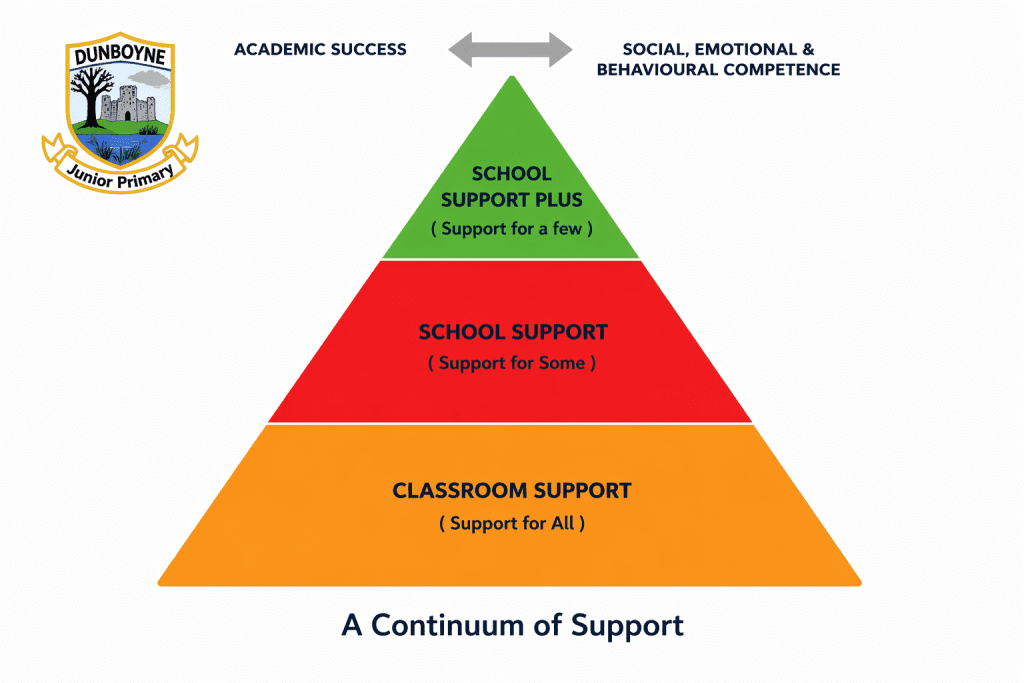
The Continuum of Support
- Classroom Support (Support for all)
- What It Is: At this level, support is provided within the general classroom setting by the Class Teacher. Teachers use various strategies to help all pupils, including those who may need extra help.
- Examples: Differentiated instruction, adjusted learning materials etc.
- Who It’s for: This is for pupils who need minor adjustments or extra help but do not require specialised support.
- School Support (Support for some)
- What It Is: When a pupil needs more focused help, the school may implement specific interventions. This level involves targeted interventions planned and delivered by the Special Education Team, in collaboration with the Class Teacher. This support is provided by Special Education Teachers in the classroom, or out of the classroom.
- Examples: Team teaching in class, small group work in or out of class, specialised teaching strategies, or targeted interventions based on individual needs.
- Who It’s for: Pupils who benefit from more intensive support than what is available in the general classroom.
- School Support Plus (Support for a few)
- What It Is: This level involves more intensive and specialised support. Support is provided by Special Education Teachers in the classroom, or out of the classroom. It often, but not always, includes additional resources and outside expertise.
- Examples: Small group or 1:1 withdrawal support, engagement with external agencies as appropriate, or more personalised plans and interventions.
- Who It’s for: Pupils with significant/complex needs who require substantial additional support to access the curriculum and make progress.
Important to note:
Children can move up and down through the levels of support.
- For example: A child receiving the highest level of support may move back through the levels, eventually needing minimal support from the Class Teacher. In this case, the child’s file would be closed, and the Class Teacher would differentiate as needed.
- For example: A child on Classroom Support may make sufficient progress with Class Teacher support and may not need to progress to further levels.
Allocation of Support Teaching
The allocation of support teaching is closely tied to the Continuum of Support. Here’s how it works in our school:
- Assessment and Identification
- Teachers and schools assess pupils’ needs based on observations, assessments, and feedback. This helps determine the level of support required. The class teacher may refer a child to the Special Education team, or it may be based on assessment data.
- Planning and Resources
- This is a needs-based model. Pupils with the highest level of need (academic, social, emotional, or behavioural) receive the most intensive support. Support may address academic, social, emotional, and behavioural needs.
- Support is allocated based on identified need within the school setting, not on the basis of diagnosis.
- A diagnosis is not required to access support and does not determine the level of support provided.
- Support Teachers
- Schools have Special Education Teachers (SET) who work specifically with pupils who need extra help. These teachers might work in class or withdraw pupils. They may provide direct instruction, help with individualised learning plans, or work alongside classroom teachers to implement interventions.
- Where appropriate, Special Education Teachers will read report recommendations and liaise with outside agencies. The school considers all recommendations from external professionals and prioritises support based on identified need and available resources.
- Planning and Review
- All pupils who have been placed on the continuum will have a School Support Plan. This will outline the current targets for the child and strategies that may be used to meet them. Planning and review are recorded using the Student Support File, in line with Department of Education guidance.
- Parents are consulted at each stage of the Continuum of Support and are actively involved in planning, reviewing, and supporting their child’s learning. We meet parents to discuss School Support Plans in October and review the plans as required. The effectiveness of interventions is regularly reviewed, and adjustments are made as needed. The aim is to ensure that pupils make progress and that support is adjusted based on their changing needs.
As resources must be allocated based on identified need, support is provided in targeted, time-bound blocks of intervention. The Special Education Teachers will work with different pupils and groups of pupils throughout the year, and their timetable will change regularly. Interventions are regularly reviewed and adjusted in line with pupil needs. Support is flexible and responsive and may change over time as pupils’ needs develop.
Key Points for Parents
– Understanding: Most children will need some support in some area over their primary school lives. This is normal and pupils enjoy the support sessions. The only aim is to help pupils progress.
– Communication: Stay in regular contact with your child’s teachers to understand the support being provided and how you can reinforce it at home.
– Involvement: Be involved in the planning and review process. Your insights are valuable in tailoring support to your child’s needs. A support teacher will be in touch by October to plan a meeting.
– Resources: Know that the school’s resources are limited, and while we will support every child to the best of our ability, it will not be possible to offer specific support teaching to children at all times. The school’s Special Education team will assess needs and review regularly.